Tuesday, May 19, 2020

Ideology & attitudes toward uncertainty (& coronavirus)

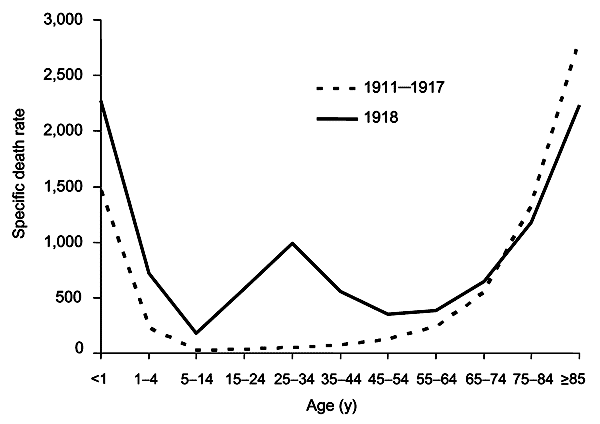
The following graph compares the mortality rates by age group of patients from two groups.
It compares:
  1. victims of the Spanish flu of 1918 with
  2. deaths throughout the 1911 to 1917 period from normal epidemics like the seasonal flu (the control group).
https://en.wikipedia.org/wiki/Spanish_flu#Mortality

The dotted line is a 'bathtub' curve which describes the usual high death rate among infants and the elderly who are afflicted by disease.

For the Spanish flu, the bathtub curve also applies.

However, there is also a big spike in the middle, with people around 35 dying in disproportionate numbers.

That is what one sees with an autoimmune response, where the body's immune system is revved into high drive and attacks the body along with the disease.

Ironically, it is the healthiest people who can suffer from the strongest autoimmune response.

An autoimmune response might be afflicting 15 children in New York City who are infected with the novel coronavirus.

https://www.cbsnews.com/news/kawasaki-disease-nyc-children-hospitalized-coronavirus-link-covid19-rare-disease/

Up until now, this has not been common among children during this pandemic, so it is of some concern.

It has been seen in some adult victims of COVID-19.

https://www.webmd.com/lung/news/20200417/cytokine-storms-may-be-fueling-some-covid-deaths

There is the danger that the more people who are infected, the more chance the virus has to mutate to cause autoimmune responses in otherwise healthy young patients.

Of course, this is not yet a reality, but merely a potentiality.

However, not taking potentialities seriously is precisely why the coronavirus was not taken seriously by many people -- perhaps most people -- when it first emerged.

Everyone was overlooking potentialities in favor of looking at evidence which had not yet come in.

Because little was known about it, it came to be assumed that the standard operating procedure that applied to the seasonal flu should also apply to the coronavirus.

Perhaps from that dubious assumption there emerged the assumption that the coronavirus was no more dangerous than the flu.

These two assumptions seemed to have been widespread.

The Chinese government and, later, Europeans and Americans seemed to adopt this position that the coronavirus was just a new flu.

In fact, much of the liberal media adopted the position that because little is known about the virus, there was no reason to panic.

https://www.foxnews.com/media/kayleigh-mcenany-media-downplaying-coronavirus
"Does Vox want to take back that they proclaim that the coronavirus would not be a deadly pandemic? Does The Washington Post want to take back that they told Americans to 'get a grip,' the flu is bigger than the coronavirus? Does The Washington Post, likewise, want to take back that our brains are causing us to exaggerate the threat of the coronavirus?
"Does The New York Times want to take back that fear of the virus may be spreading faster than the virus itself? Does NPR want to take back that the flu was a much bigger threat than the coronavirus? And finally, once again, The Washington Post, would they like to take back that the government should not respond aggressively to the coronavirus?"
Along those lines, it is said to be Jared Kushner who advised Trump to ignore the coronavirus threat because it was probably unjustified.

Kushner is reported to have advised Trump that if the Dow Jones industrial average reached 35,000, then Trump would be reelected.

Therefore, it was best not to spook the stock market with talk of a pandemic.

This advice did not reflect some extreme right-wing belief that the coronavirus was a hoax.

Historically, Jared Kushner has been a Democrat.

It was simply widely assumed that the coronavirus was not something to get worked up about.

There seem to be several lines of reasoning in the denial of the pandemic.

For some conservatives, there is no reason to get excited and carried away from our usual routine.

For populists, any kind of imposition by the federal government is a form of tyranny.

For progressives, if there is no clear evidence of a threat, then there is no threat.

One finds this progressive line of thinking in Carl Sagan's 1997 movie "Contact".

The military urges public officials to not build a structure presumably for space travel that seemed to have been designed by advanced extraterrestrial beings.

In the movie, the military was cast as as a stubbornly close-minded adversary, if not an outright enemy (a role played by populist religious fanatics).

And yet the physicist Stephen Hawking agreed with the military's cautious appraisal toward alien life forms.

Humans should not advertise their existence in the universe by trying to contact alien civilizations.

Extraterrestrials are like a box of chocolate.

You never know what you're going to get.

https://www.theguardian.com/commentisfree/2016/sep/27/stephen-hawking-light-years-dangerous-aliens

Actually, Hawking seemed to support the SEARCH for intelligent life in the universe, but was cautious about trying to contact them.

Hawking also warned of the potential dangers of artificial intelligence.

https://www.cnbc.com/2017/11/06/stephen-hawking-ai-could-be-worst-event-in-civilization.html

Again, the problem is not AI, but what is not yet known about AI.

AI can and should be pursued, but carefully, with sobriety.
Hawking talked up the potential of AI to help undo damage done to the natural world, or eradicate poverty and disease, with every aspect of society being “transformed.” 
But he admitted the future was uncertain
“Success in creating effective AI, could be the biggest event in the history of our civilization. Or the worst. We just don’t know. So we cannot know if we will be infinitely helped by AI, or ignored by it and side-lined, or conceivably destroyed by it,” Hawking said during the speech.
“Unless we learn how to prepare for, and avoid, the potential risks, AI could be the worst event in the history of our civilization. It brings dangers, like powerful autonomous weapons, or new ways for the few to oppress the many. It could bring great disruption to our economy.”
It could be that political progressives typically have generally optimistic attitude change (neophilia) and outsiders (xenophilia).

The optimistic mentality of the progressive is likeable and understandable.

We are exposed to it in every episode of Star Trek.

What is really problematic is not the irrational optimism of the rationalistic progressive, but the adolescent mind-frame of the romantic.

Whereas the progressive merely overlooks or explains away uncertainty, the romantic is downright enchanted and intoxicated by the very prospect of uncertainty.

For the romantic, uncertainty has an air of infinity possibilities.

The romantic is attracted to gambling when the stakes are unknown and the potential seems vast (e.g., the neoconservative attitude toward the potential invasion of Iraq).

In the 1998 movie "Croupier", the narrator explains that the appeal of gambling is not money, but rather "not facing reality, ignoring the odds."

https://en.wikiquote.org/wiki/Croupier_(film)

That is a very different attitude from the world weariness of the professional gambler who knows the odds and all the angles.

["Rounders", 1998, "I play for money"]


The appeal of games is that the system is closed and regulated, there are explicit and transparent rules, and that competitors are known and played against discretely.

Moreover, a game is a closed environment in which the consequences to winning or losing do not outlast the game, yet the game can simulate in safe form the excitement of competition.

The casino is a closed system, so the odds can be known.

Yet most people who gamble don't even want to know the odds because they are intoxicated by the false promise of uncertainty.

When people walk into a casino, they become romantic dreamers and they disregard the odds.

So a casino is doubly seductive.

First, the casino offers a false sense of safety.

The reality is that you can actually lose everything you have in that casino.

Second, the casino provides a false sense of infinite possibilities.

In reality, the casino has very precisely stacked the odds against you.

The real world is not a safe closed environment, the real world is open and ambiguous.

Along these lines, the odds keep changing with the coronavirus.

But a lot of people are not pivoting with the constantly changing flood of new information.

In the initial period of the virus emerging in China, the virus was widely dismissed as being no more dangerous than the flu.

After this initial period of low information, more information started to appear in the media.

In this secondary period, as more information became available, certain basic assumptions began to take form:
  • It was estimated that two-thirds of humanity would be infected, and that the death rate would be two percent.
  • That would mean four million dead Americans if no measures were taken.
  • The South Koreans, with their extensive testing, claimed that the death rate among the infected was more like 0.6%.
  • That would still be 1.2 million dead Americans.
  • Of course, that is nothing like the bubonic plague, which killed somewhere between one-third and two-thirds of the European population in the 1300s, yet the coronavirus death rate is enough to overwhelm the healthcare system, and this was the reason initially given to justify the lockdowns.
  • Not taking measures against the pandemic would also demoralize society, and not just in the sense of emotional depression.
  • A certain cynicism and a loss of social cohesion would permanently creep into a society that shrugged off the deaths of so many people.
Much of the American population seems stuck in the first period and its assumption that the coronavirus is inconsequential.

In fact, that might also be true of Sweden, where government policy urged Swedes to take voluntary precautions against coronavirus without enforcement.

Swedish authorities now acknowledge that they thought that their death rate would be much lower than it turned out.

That is, Swedish coronavirus policy has been a failure.

Nevertheless, the policy remains popular in Sweden.

https://www.businessinsider.com/coronavirus-sweden-lockdown-chief-says-high-death-toll-was-surprise-2020-5

The world seems to be entering a third stage of understanding regarding the coronavirus.

Comparative public policy responses to the coronavirus have altered public perceptions.

There seems to be a sense that responding to the coronavirus with strong measures does not involve a trade-off between economic growth and public safety.

Economically, there seem to be several scenarios that the coronavirus presents to societies:
  • Test aggressively and avoid both deaths and a lockdown, and economically thrive thereafter (South Korea)
  • Fail to test and then enter a strict lockdown, followed by testing and by a recession (China)
  • Enter a semi-lockdown, with a relatively high death rate, and have a severe recession, with the population losing confidence (United States)
  • Don't do anything (Brazil)
It should be noted that only very recently have these several distinct scenarios been observed.

Again, the issue here is uncertainty.

Perceptions keep changing because the realities on the ground continue to evolve.

Recently, more ambiguities have emerged.
There are comorbidities such as organ failure that later afflict coronavirus survivors.

There is the possibility that there will never be a vaccine because there is the possibility that humans cannot develop lasting immunity to the coronavirus.

There are reports that the virus has mutated into a more contagious new strain, which some observers disclaim.

There is the possibility that the pandemic will never go away, that it will become seasonal.

There is the the possibility that with greater contagiousness and a permanent presence, the virus will have greater opportunity to mutate.

If it mutated into an autoimmune disease, the disease would reinfect and kill young adults who were earlier so confident of their indestructibility.

If fact, in NYC, there is limited evidence of this with 15 very young victims.


On the other hand, who knows?

Sunday, May 17, 2020

Estonia's e-government as "trifecta innovation"? (cryptocurrency & blockchain)

In terms of public safety, one of the best things that a government could do would be to put all of its bureaucratic functions online.

This is the policy position of the Estonian government.
Estonia has put all of its bureaucratic government functions online.
https://en.wikipedia.org/wiki/E-Estonia
e-Estonia refers to a movement by the government of Estonia to facilitate citizen interactions with the state through the use of electronic solutions. E-services created under this initiative include:
  • i-Voting,
  • e-Tax Board,
  • e-Business,
  • e-Banking,
  • e-Ticket,
  • e-School,
  • University via internet,
  • the e-Governance Academy , as well as
  • the release of several mobile applications.
It saves Estonia 2% of its GDP.
It is also a highly secure system.
In fact, security was one of the objectives of the system, because Russia was always a problem for Estonia.
The data for e-Estonia is not stored centrally, but instead uses a data platform run by the government called X-Road to link information from local hosts.[2] The system is backed up on servers in Luxembourg, which is governed with the same protections afforded for a diplomatic mission.[2] The system is designed to allow the government of Estonia to function even in the event of an invasion by Russia.
It is both rigorous and transparent, a model of preparedness.
Individuals are able to access all e-Estonia data about themselves, and all queries to the system are logged.
https://www.techrepublic.com/article/how-estonia-became-an-e-government-powerhouse/
Today, 99% of the public services are available online 24/7, 30% of Estonians use i-Voting, and the country estimates the reduced bureaucracy has saved 800 years of working time.
There were three foundational projects.
  • Digitizing registers held by public bodies to provide the necessary information to support e-services;
  • building the X-Road platform that connects the wealth of different systems used in the public and private sector and allows them to share information; and
  • giving citizens the means to securely access online services by providing digital ID cards and making digital signatures equivalent to handwritten signatures.
While Estonia's e-government can serve as an inspiration, countries must tailor such a project to their own unique circumstances and learn from setbacks in Estonia's experience.
With public safety in mind, much of the criminal justice system has been virtualized.
https://www.newyorker.com/magazine/2017/12/18/estonia-the-digital-republic
In Tallinn’s courtrooms, judges’ benches are fitted with two monitors, for consulting information during the proceedings, and case files are assembled according to the once-only principle. The police make reports directly into the system; forensic specialists at the scene or in the lab do likewise. Lawyers log on—as do judges, prison wardens, plaintiffs, and defendants, each through his or her portal. The Estonian courts used to be notoriously backlogged, but that is no longer the case.
“No one was able to say whether we should increase the number of courts or increase the number of judges,” Timo Mitt, a manager at Netgroup, which the government hired to build the architecture, told me. Digitizing both streamlined the process and helped identify points of delay. Instead of setting up prisoner transport to trial—fraught with security risks—Estonian courts can teleconference defendants into the courtroom from prison.
Estonia votes online.
The first “killer application” for the I.D.-card-based system was the one that Martens still works on: i-voting, or casting a secure ballot from your computer. Before the first i-voting period, in 2005, only five thousand people had used their card for anything. More than nine thousand cast an i-vote in that election, however—only two per cent of voters, but proof that online voting was attracting users—and the numbers rose from there. As of 2014, a third of all votes have been cast online.
Estonia's e-government relies on blockchain technology for security.
Records are kept on one long digital ledger comparable to a single, infinitely long knitted scarf.
Beyond X-Road, the backbone of Estonia’s digital security is a blockchain technology called K.S.I. A blockchain is like the digital version of a scarf knitted by your grandmother. She uses one ball of yarn, and the result is continuous. Each stitch depends on the one just before it. It’s impossible to remove part of the fabric, or to substitute a swatch, without leaving some trace: a few telling knots, or a change in the knit.
Because the blockchain records all transactions continuously, no discrete information can be deleted or added.
People understandably worry that this compromises security because personal information is open to public view.

However, because records cannot be altered, the sacrifice of privacy to transparency means that records can never be illicitly altered.
In a blockchain system, too, every line is contingent on what came before it. Any breach of the weave leaves a trace, and trying to cover your tracks leaves a trace, too. “Our No. 1 marketing pitch is Mr. Snowden,” Martin Ruubel, the president of Guardtime, the Estonian company that developed K.S.I., told me. (The company’s biggest customer group is now the U.S. military.) Popular anxiety tends to focus on data security—who can see my information?—but bits of personal information are rarely truly compromising. The larger threat is data integrity: whether what looks secure has been changed. (It doesn’t really matter who knows what your blood type is, but if someone switches it in a confidential record your next trip to the emergency room could be lethal.) The average time until discovery of a data breach is two hundred and five days, which is a huge problem if there’s no stable point of reference. “In the Estonian system, you don’t have paper originals,” Ruubel said. “The question is: Do I know about this problem, and how quickly can I react?”
With blockchain, all data is permanently set in place and open to inspection.
Also, backups of data can established in other places.
The blockchain makes every footprint immediately noticeable, regardless of the source. (Ruubel says that there is no possibility of a back door.) To guard secrets, K.S.I. is also able to protect information without “seeing” the information itself. But, to deal with a full-scale cyberattack, other safeguards now exist. Earlier this year, the Estonian government created a server closet in Luxembourg, with a backup of its systems. A “data embassy” like this one is built on the same body of international law as a physical embassy, so that the servers and their data are Estonian “soil.” If Tallinn is compromised, whether digitally or physically, Estonia’s locus of control will shift to such mirror sites abroad.
In the event of an invasion, Estonia's population would be captured, killed or scattered across the globe.
Even after that hypothetical invasion, the Estonian government would still function because it has been put online.
If Russia comes—not when—and if our systems shut down, we will have copies,” Piret Hirv, a ministerial adviser, told me. In the event of a sudden invasion, Estonia’s elected leaders might scatter as necessary. Then, from cars leaving the capital, from hotel rooms, from seat 3A at thirty thousand feet, they will open their laptops, log into Luxembourg, and—with digital signatures to execute orders and a suite of tamper-resistant services linking global citizens to their government—continue running their country, with no interruption, from the cloud.
Here is more specific description of blockchain technology.

https://en.wikipedia.org/wiki/Blockchain#Structure
A blockchain is a decentralized, distributed, and oftentimes public, digital ledger that is used to record transactions across many computers so that any involved record cannot be altered retroactively, without the alteration of all subsequent blocks.[1][17] This allows the participants to verify and audit transactions independently and relatively inexpensively.[18] A blockchain database is managed autonomously using a peer-to-peer network and a distributed timestamping server. They are authenticated by mass collaboration powered by collective self-interests.
One question here is whether Estonia's e-government is "disruptive".
In "disruptive innovation", a simple product in a fringe market finds a niche, improves over time, and displaces the mainstream market unexpectedly.
https://en.wikipedia.org/wiki/Disruptive_innovation
In business theory, a disruptive innovation is an innovation that creates a new market and value network and eventually disrupts an existing market and value network, displacing established market-leading firms, products, and alliances.
This disruptive innovation is distinct from both:
  • sustaining innovation, in which the dominant, mainstream product becomes more sophisticated over time, and
  • efficiency innovation, in which a product more efficient and less expensive.
Before examining the innovativeness of e-government, a quick review of the innovativeness of blockchain technology might be useful.
Blockchain technology is the foundation of cryptocurrencies like bitcoin.
That raises another question.

Are cryptocurrencies innovative?

Is cryptocurrency a cheaper, technologically inferior form of money that is improving over time and will displace "normal" forms of money?

Normal forms of money include "paper" money (actually, dyed cloth) as well as electronic transmissions, such as the use of credit cards and online payment systems like PayPal.

It seems clear that cryptocurrency, while a marginal form of currency in a market of its own, is neither technologically inferior to nor cheaper than incumbent forms of currency.
Cryptocurrency is not disruptive innovation, properly speaking.
But neither is cryptocurrency a sustaining innovation because it is not the dominant product in the mainstream market that is becoming more sophisticated.

Cryptocurrency is not a sustaining innovation, in which the mainstream incumbent product grows more sophisticated and moves up market.

Cryptocurrency exists in a separate market than the mainstream because it has two primary uses -- speculation and money laundering.

Today, anyone can go online and dabble in the stock market as a speculator, so even speculation in cryptocurrency is not especially disruptive in the world of speculation.

Likewise, using cryptocurrency for money laundering seems neither the cheaper, inferior disruptive option nor a superior, sophisticated sustaining innovation.
Is cryptocurrency more efficient than regular currency?
The production of bitcoin is energy intensive.

https://www.vox.com/2019/6/18/18642645/bitcoin-energy-price-renewable-china
According to the bitcoin energy consumption tracker at Digiconomist, bitcoin currently consumes 66.7 terawatt-hours per year. That’s comparable to the total energy consumption of the Czech Republic, a country of 10.6 million people.
Credit card companies and banks host a much greater number of financial transactions than do cryptocurrencies, but they do not burn through electricity the way cryptocurrency does.
Cryptocurrency is not an efficiency innovation.
Cryptocurrencies are energy intensive because they rely of blockchain technology, which is not more energy efficient than regular systems of financial transaction.
But neither is blockchain technology a disruptive technology which is cruder and simpler than the what the mainstream market has to offer.
And neither is blockchain a sustaining innovation because it is not a more sophisticated version of the incumbent product.
However, if blockchain is used as the basis of governmental transactions, it does seem to be a form of disruptive innovation.
Blockchain technology in e-government is disruptive innovation.
That is, blockchain records are something simpler that originated from another field entirely on the fringes (cryptocurrency) that has displaced physical government records in Estonia.

Are blockchain-based government records a form of sustaining innovation, that is, a more sophisticated version of the already dominant mainstream product?

Insofar as Estonia might have already put citizens' personal information online, blockchain records would have been an advanced version of that because blockchain is more secure.
Blockchain technology in e-government is sustaining innovation.
Are blockchain-based government records an innovation toward efficiency?

Insofar as the government of Estonia saves 2% of its GDP because it has shifted to e-government, blockchain-based government records do seem to be more efficient.
Blockchain technology in e-government is efficiency innovation.
And here we come to a pet theory.

This is the concept of "trifecta innovation".
In a trifecta innovation, a product has qualities of disruptive, sustaining and efficiency innovation.
Uber is an example of trifecta innovation.
Clayton Christensen pointed out that, contrary to popular perception, Uber was not a classic case of disruptive innovation.
Uber was launched within the world of elite "black car" taxi service as a sustaining innovation by using a smartphone app for ride hailing.
That is, Uber originated as an improvement of a mainstream product, not an inferior product in a fringe market.
However, insofar as Uber got people who would never use a taxi to use ride hailing, Uber created a new fringe market that disrupted taxi companies.
This disruptive innovation on Uber's part is distinct from the initial phase of creating a ride hailing app within the upscale taxi market.

The creation of a new fringe market in the second phase was something distinct that involved the early formation of the gig economy.
Uber was also an efficiency innovation that drove down prices.
In the early, quasi-idealistic phase of Uber adoption, Uber was largely a ride-SHARING service.

A driver who was heading across town anyway could help defer the cost of their trip by taking on a passenger, also thereby broadening their social life.

This was an efficiency innovation in private transportation.

That the passenger was saving money on a taxi was a feature of disruptive innovation, but insofar as the driver was also saving money (on gasoline) was a feature of efficiency innovation.

Recently, Uber has been criticized as a perpetual unprofitable enterprise propped up by its questionable stock market valuation.


But then that's also what they said about Amazon.

Monday, April 6, 2020

The proper function of the electoral college? (The long shadow of tyrants and demagogues)

Is there a possibility that some of the electors in the electoral college may vote for a moderate candidate from the opposition?

There are calls for the abolition of the electoral college.

https://en.wikipedia.org/wiki/United_States_Electoral_College
The Electoral College is a body of electors established by the United States Constitution, which forms every four years for the sole purpose of electing the president and vice president of the United States. The Electoral College consists of 538 electors, and an absolute majority of at least 270 electoral votes is required to win the election.
The electoral college in some respects might be described as a temporary parliament that has the sole function of choosing the national leader.

In a parliament, members who are elected try to form a dominant coalition, from which an acceptable member is chosen to be prime minister.

https://en.wikipedia.org/wiki/Parliamentary_system#Characteristics

The obvious difference between a parliament and the electoral college is that presidential elections are directly voted for by the people of the USA.

The college's electors in each state are determined by which presidential candidate in that state had the most votes.

But the elector can turn against the candidate of their own party in casting their own vote.

States have subsequently passed laws that force electors to vote for the candidate who received a majority of the votes in that state.

This is unconstitutional nonsense.

The original meaning of the Constitution is that electors are intermediaries between the popular vote and who ends up in the White House.

The electors are supposed to genuinely decide the election.

Today, the effort to abandon the electoral college is mostly on the part of the Democratic Party.

Because of the electoral college, the Democrats lost a couple of recent presidential elections despite their candidate winning the popular vote.

The Democrats desire to dismantle the electoral college resembles the ever-changing sentiments toward the line-item veto.

The line-item veto gives the President powerful editing power over bills that are given to him to sign into law.

The political party that has one of its members in the office of the POTUS loves the line-item veto, and the opposition hates it.

Likewise, there is some chance that the party that now complains about the electoral college may benefit in the near future from the electoral college.

One must look to the theoretical purposes given in support for the electoral college to understand this.
There was one particular historical legal and practical reason for the electoral college that involved moral compromise.

https://en.wikipedia.org/wiki/United_States_Electoral_College
  • Congressional power was slanted toward smaller states (via the Senate) and slave-holding states (via the House, where slave states were given three seats for every five slaves). Basing the electoral college on this design would make it more appealing than the direct popular vote to the small states and the slave states, whose power was decisive.
There were also theoretical reasons.

First, there was a desire for balance.
  • Originally, like a parliamentary system, Congress was to elect the president, but this was seen to conflict with the separation of powers.
  • The Constitution was designed to find a balance between the interests of the general population (House) and the concerns of the states (Senate), a principle which an electoral college also satisfied.
Second, there was concern about potential corruption.
  • Because the electoral college is a temporary institution reconstituted every four years, its temporary members would be less likely to become corrupted or conspiratorial.
  • The electors would make their decisions in the localities that chose them. They would thus be familiar with local issues and distant from the temptations of power in Washington, DC.
Third, there was an elitist disdain for populist demagoguery and selfishness.
  • The electoral college would weed out a candidate who was unqualified yet possessed a talent for "low intrigue, and the little arts of popularity".
  • The electoral college reflected the hierarchical virtues of republicanism and federalism, which militated against selfish and destabilizing factionalism.
The hallmark of the Constitution was the principle of balance and compromise.

When historians look back on American civilization thousands of years from now, they will marvel at three things: baseball, jazz and the Constitution.

All three embody the American genius for improvisation.

https://www.pbs.org/kenburns/jazz/note-from-ken-burns

Perhaps outshone by their creativity, it is easy to miss that baseball, jazz and the Constitution are also paragons of balance and compromise.

Hence, the purpose of the Constitution: to replace a populist confederate direct democracy with a more elitist stable federal republic while preserving the essence of democracy.

The electoral college was itself a compromise between the extremes of direct democracy, on the one hand, and a having an unacceptably exclusive and inbred group of electors (Congress), on the other.

The most important function of the electoral college was to prevent a tyrant from seizing power.

The tyrants of ancient Greece cast a long shadow over Western political history.

The tyrant was an ambivalent figure for the Greeks.

Despite their own aristocratic backgrounds, the tyrants seized power in city-states and shifted power away from the aristocracy to themselves.

The tyrant is power mad, and over time he would degenerate into paranoia and cruelty.

However, in order to keep power, the tyrants reformed their city-states and made the city-states wealthy, powerful and egalitarian -- and thereby made democracy possible.

The Greek philosophers developed various theories of how societies evolve politically.

This political development was typically perceived as a three-stage cycle in which the tyrant played a central role.

Society starts out as mob rule (ochlocracy).
  1. It then becomes a monarchy, which degenerates into tyranny.
  2. It then becomes an aristocracy, which is corrupted into oligarchy.
  3. It then becomes a democracy, which degrades into mob rule.
  4. And the cycles repeats itself again.
https://en.wikipedia.org/wiki/Kyklos
According to Polybius, who has the most fully developed version of the cycle, it rotates through the three basic forms of government, democracy, aristocracy, and monarchy and the three degenerate forms of each of these governments ochlocracy (mob rule), oligarchy, and tyranny. Originally society is in ochlocracy (mob rule) but the strongest figure emerges and sets up a monarchy. The monarch's descendants, who because of their family's power lack virtue, become despots and the monarchy degenerates into a tyranny. Because of the excesses of the ruler the tyranny is overthrown by the leading citizens of the state who set up an aristocracy. They too quickly forget about virtue and the state becomes an oligarchy. These oligarchs are overthrown by the people who set up a democracy. Democracy soon becomes corrupt and degenerates into ochlocracy (mob rule), beginning the cycle anew.
In ratifying the Constitution, the USA adopted a mixed form of government, with executive (monarchic), judicial (aristocratic) and legislative (democratic) branches.

By institutionalizing each form of government found in the Greek theory of the cycle of political history, the Constitution was meant to inhibit the tumult of the cycle.

Because of the Greek political experience, there might continue to be an ambivalence in the modern world toward upper-class reformists like the Kennedys and the Roosevelts.

https://en.wikipedia.org/wiki/Gracchi

There might be two recent American presidents who fit some of the description of a tyrant, but in very different ways.

The first is George W. Bush.

Born into a political dynasty, Bush had a resentful, rebellious streak, a hatred of elites and a love of ordinary folks.

This pushed him not towards the left, but toward a new kind of conservatism -- the neoconservative movement.

Bush ran for president preaching limited conservative reform (for example, introducing Christian the teaching into prisons that saved his own life).

Despite professing limited government, Bush harbored extreme ambitions to revolutionize every aspect of American policy.

Bush covertly championed the grandiose neoconservative agenda dreamed up largely by Jewish academics who were former communists.

Yet despite this policy overreach, Bush did not seek to amass power either for his office or for himself.

The second quasi-tyrant is Richard Nixon.

Unlike Bush, Nixon was born into poverty.

Nixon was a typical conservative who, distracted by the Vietnam War, largely allowed or even encouraged Congress to push through liberal legislation.

In the context of the Cold War, however, Nixon sought as a matter of national security to secretly vest government power in the executive branch -- that is, in himself.

Also, after a lifetime of being mocked by and discriminated against by refined rich people, Nixon was a genuine paranoiac -- a classic feature of the tyrant.

But its not just tyrants from the upper classes at the early stage of the cycle who threatened society according to the Greek theory of political cycles.

At the end stage of the cycle -- mob rule -- society was susceptible to the insidious influence of demagogues.

https://en.wikipedia.org/wiki/Anacyclosis
Accordingly, democracy degenerates into "ochlocracy", literally, "mob-rule". In an ochlocracy, according to Polybius, the people of the state will become corrupted, and will develop a sense of entitlement and will be conditioned to accept the pandering of demagogues.
https://en.wikipedia.org/wiki/Demagogue
A demagogue /ˈdɛməɡɒɡ/ (from Greek δημαγωγός, a popular leader, a leader of a mob, from δῆμος, people, populace, the commons + ἀγωγός leading, leader)[1] or rabble-rouser[2][3] is a leader who gains popularity in a democracy by exploiting emotions, prejudice, and ignorance to arouse the common people against elites, whipping up the passions of the crowd and shutting down reasoned deliberation.[1][4] Demagogues overturn established norms of political conduct, or promise or threaten to do so.
"What is a demagogue? He is a politician skilled in oratory, flattery and invective; evasive in discussing vital issues; promising everything to everybody; appealing to the passions rather than the reason of the public; and arousing racial, religious, and class prejudices—a man whose lust for power without recourse to principle leads him to seek to become a master of the masses. He has for centuries practiced his profession of 'man of the people'. He is a product of a political tradition nearly as old as western civilization itself."
Demagogues have appeared in democracies since ancient Athens. They exploit a fundamental weakness in democracy: because ultimate power is held by the people, it is possible for the people to give that power to someone who appeals to the lowest common denominator of a large segment of the population.[7] Demagogues usually advocate immediate, forceful action to address a crisis while accusing moderate and thoughtful opponents of weakness or disloyalty. Once elected to high executive office, demagogues typically unravel constitutional limits on executive power and attempt to convert their democracy to dictatorship.
  • They present themselves as a man or woman of the common people, opposed to the elites.
  • Their politics depends on a visceral connection with the people, which greatly exceeds ordinary political popularity.
  • They manipulate this connection, and the raging popularity it affords, for their own benefit and ambition.
  • They threaten or outright break established rules of conduct, institutions, and even the law.
The classic methods of the demagogue:
A classic American demagogue would be Huey Long.

Huey Long was a left-wing populist politician from Louisiana who sought the presidency during the Great Depression.

https://en.wikipedia.org/wiki/Huey_Long
As the political leader of Louisiana, he commanded wide networks of supporters and was willing to take forceful and dictatorial action. He established the long-term political dominance and dynasty of the Long family.
Much like a tyrant, Huey Long was a dynamic leader who built up Louisiana's economy, which was always backwards, during the ravages of the Depression.
During Long's years in power, large expansions were made in infrastructure, education and health care. Long was notable among southern politicians for avoiding race baiting and white supremacy, and he sought to improve the conditions of impoverished blacks as well as impoverished whites.[1] Under Long's leadership, hospitals and educational institutions were expanded, a system of charity hospitals was set up that provided health care for the poor, and massive highway construction and free bridges brought an end to rural isolation. 
A Democrat and an outspoken left-leaning populist, Long denounced the wealthy urban Baton Rouge and D.C. elites, oligarchs and the banks. Initially a supporter of Franklin D. Roosevelt during his first 100 days in office, Long eventually came to believe that Roosevelt's "New Deal" policies were an insufficient compromise and did not do enough to alleviate the issues of the poor or tackle the Depression. As a result, he developed his own solution called the "Share Our Wealth" program, which would establish a net asset tax, the earnings of which would be redistributed so as to curb the poverty and homelessness epidemic nationwide during the Great Depression.[2]
Long's Share Our Wealth plan was established on February 23, 1934, with the motto "Every Man a King." To stimulate the economy, Long advocated extensive federal spending on public works, schools and colleges, and old age pensions. Long argued that his plan would enable everyone to have at least a car, a radio, and a home worth $5,000.[2]
Shrewd and ambitious, Huey Long allied himself with fascists in his run for president.
Long split with Roosevelt in June 1933 to plan his own presidential bid for 1936 in alliance with the influential Roman Catholic priest and rightwing populist radio commentator Father Charles Coughlin. Long however was assassinated in 1935, and his national movement soon faded, but his legacy continued in Louisiana.
Interestingly, even though Huey Long was from one of the poorest areas of Louisiana, he was from a well-educated and reasonably well-off family.

Rather than being a classic tyrant from the aristocracy, Long was a classic "semi-have".

He was talented, ambitious and well-educated, yet a disgruntled outsider.
The degree of poverty in Winn Parish was extreme, but in general Louisiana was a very poor state, with the 1930 census showing that one-fifth of White Louisianans were illiterate, with rates for Black Louisianans being much higher. As someone who was born and grew up in Winn Parish, Long inherited all of the resentments of its people against the elite in Baton Rouge who ruled Louisiana.[9] While Long often told his followers that he came from the lowest possible social and economic stratum, the reality is that Long's family were well-off compared to others in the largely destitute community of Winnfield.
For people of their time and socioeconomic standing, Long's parents were well-educated, and stressed often to their child the importance of learning.[6] For many years, Long was home-schooled, although when he was 11 he began attending local schools. During his time in the public system, he earned a reputation as an excellent student with a remarkable memory. After growing bored with his required schoolwork, he eventually convinced his teachers to let him skip seventh grade.[11] When he was a student at Winnfield High School, he and his friends formed a secret society, which they broadcast to others by wearing a red ribbon. According to Long, his club's mission was "to run things, laying down certain rules the students would have to follow."
The teachers at the school eventually learned of Long's antics and warned him to obey the school and its faculty's rules. Long continued to rebel, eventually writing and distributing a flyer that criticized both his teachers and the necessity of a recently mandated twelfth grade. This resulted in his expulsion in 1910. Long sought revenge by drafting up a petition calling for the principal of Winnfield High School to be removed from his post. He managed to convince enough people in his town to sign it, resulting in the principal's being fired.
Huey Long was a magnetic and talented public speaker.

[Huey Long, "Share the wealth"]


Donald Trump is an interesting political figure.

Despite his inherited wealth, Donald Trump does not fit the typical profile of the upper-class reformist tyrant.

First, he has none of the refined traits of the upper class, such as education and good taste.

Second, he has never had a political consciousness or an interest in public policy, only a desire for attention.

Rather, in his public persona, Trump resembles the "semi-have" outsider demagogue who has a gift for the "common touch".

Because of his approachable, unpretentious personality, his self-parodying sense of humor and his flashy personal style, Trump has the ability to pass himself off as a self-made man.

Trump's wealth thus raises the approval rather than the resentment of the lower classes.

Trump's appeal among the "poorly educated" (in his words) is buttressed by his genuine yet amorphous feelings of being persecuted by the establishment.

Yet despite his demagoguery, in some ways, Trump does not fit the picture of a would-be revolutionary.

Trump lacks political beliefs, has no real political agenda, has no idea how government functions and is almost purely focused on public image (Twitter) and on his own personal wealth.

Ironically, because the Republican establishment knew that Trump would be a passive and inept office holder, they chose to reconcile themselves to him for their own profit and power.

In this light, there has been a shift in Donald Trump's rhetoric since the 2016 election.

Trump was elected based on his populist appeal.

Trump promised to be a revolutionary who would change everything.

In fact, once in office, Trump did not even try to change anything.

In the 2020 election, Trump's rhetoric lost its populist anger and took on a nostalgic, complacent tone.
One stark example of this was Trump's dismissal of the South Korean movie "Parasite" winning the Academy Award for best picture.

Trump stated “Can we get like ‘Gone with the Wind’ back please? ‘Sunset Boulevard,’ so many great movies.”

Trump's rejection of a Korean movie and praise for "Gone with the Wind" is seen as an example of racism.

But this misses a couple of big points.

First, "Parasite" was a populist critique of inequality.

Still appealing to nationalism, Trump is backpedaling furiously away from his old populism.

Second, "Gone with the Wind" and "Sunset Boulevard" are old films, and Trump is evoking a reactionary nostalgia.

Moreover, subject of both of those films is nostalgia itself -- for the long, lost aristocratic antebellum South and for the glory days of a faded movie star's career, respectively.

Also, the main figures in the two films are wealthy women.

Trump's rhetoric is still nationalist, but no longer populist, no longer revolutionary.

The Republican Party does have its own sincere point of view that includes a fear of tyrants and demagogues.

From their point of view, the two political figure who conforms more perfectly to the stereotype of the dangerous, would-be tyrant or demagogue are Hillary Clinton and Barrack Obama.

She is the strident, immensely capable, diligent, educated outsider who self-righteously seeks to enrich herself even while she sincerely seeks serious societal reform.

Likewise, Barack Obama was a charismatic, articulate, highly educated, cynically ambitious outsider who was so determined to make his mark in policy.

The Republican electors might never vote for HRC or Obama in the shadow of the figure of the tyrant or the demagogue.


But they might cast a ballot for a mainstream, moderate, old political pro of the opposition party if they perceive the alternative in their own party to be more similar to a tyrant or demagogue.

Friday, April 3, 2020

Will coronavirus cause rural collapse?

  • Rural areas seem better positioned to be isolated from the coronavirus.
  • Despite decreased density and global connectedness, rural areas might be more vulnerable in other ways.
  • Rural areas are poorer and have fewer health care resources.
  • There is also the factor of attitude.
    • The East Asian countries that have responded most successfully to the pandemic had long prepared themselves to do so because of their previous experience with SARS and MERS.
    • In the case of Europe, the countries that are suffering now from the pandemic have a reputation for not taking the rule of law seriously.
    • In the USA, attitudes toward coronavirus fall along familiar political, cultural and geographic fault lines.
  • However, the resistance to social distancing is not inherently conservative.
  • In the USA in particular, there is a libertarian and populist streak in the flaunting of calls to self-isolate.
  • Conservatism leans toward caution and realism, but this disposition can play out in at least two ways.
    • The classic conservative response is to immediately guard against risk.
    • Depending on how far the remedy diverges from familiarity and tradition, there might be a tendency in the conservative character to waffle in the face of outside threats.
  • Also, today, conservatives in the USA are allied with libertarians and populists.
  • American conservatives can be seen as the conservative wing of liberalism.
  • Both major political parties in the USA are ultimately liberal.
  • In terms of American conservatism, however, there is a pocket or reservoir of organic traditionalism embedded within the liberal individualist paradigm.
  • That is, the European conservative ideal of the organically united society lives on in the USA -- although this ideal is largely not applied at the societal level.
  • Uniquely, in the USA, this organic conservatism is largely relegated to the private realm within the framework of a liberal, individualistic, capitalistic society.
  • Again, for European conservatives, society is a complex organic whole.
  • In conservative rural America, this holism transferred onto the microcosm of the family and community.
  • The family and the small town are perceived as complex organisms within an atomisitic liberal worldview.
  • In the modern world, there is thus "eversion" or turning inside-out of the traditional worldview.
  • Hence, the transformation and privatization of conservatism's organic ideal amid the hegemony or domination of a liberal order and an atomistic worldview.
  • Populism is something altogether different from conservatism or liberalism.
  • However, because of the USA's unique historical development, those who are the most populist tend to be the most libertarian.
  • Certain populist rural areas of the USA were particularly slow to act in the coronavirus pandemic.
  • These areas might become more afflicted with the coronavirus than the more urban, liberal areas.
  • The complacent small towns that already have so many problems may be permanently laid waste.
  • In fact, cities may emerge more vibrant than they already were.
The coronavirus is afflicting New York City much more than it is impacting Los Angeles.

That might be predictable.

NYC is famous for its density, and LA is famous for its sprawl.

Also, its much more cold this time of year in NY than in CA.
Rural areas seem better positioned to be isolated from the coronavirus.
Internationally, however, it is provincial areas -- Wuhan, northern Italy, Spain -- that have been hardest hit by the coronavirus.
Despite decreased density and global connectedness, rural areas might be more vulnerable in other ways.
Rural areas are poorer and have fewer health care resources.
Also, rural areas tend to have older populations.

https://www.vox.com/2020/3/28/21197421/usa-coronavirus-covid-19-rural-america
It’s these kinds of equations that make epidemiologists particularly concerned about rural America. “If we believe that the way seasonal flu spreads through the country is likely similar to Covid-19, the rural eruptions tend to be later and briefer, but more impactful than in big urban areas,” said Roger Ray, a retired neurologist, physician executive, and physician consulting director with The Chartis Group.
There is also the factor of attitude.
Some people are taking the coronavirus crisis more seriously than others.
The East Asian countries that have responded most successfully to the pandemic had long prepared themselves to do so because of their previous experience with SARS and MERS.
A lack of seriousness might explain why in Europe, it is provincial areas that have been most afflicted by the coronavirus.
In the case of Europe, the countries that are suffering now from the pandemic have a reputation for not taking the rule of law seriously.
For example, Italians either regard laws as interesting suggestions or as personal challenges to creatively evade.

https://www.citylab.com/life/2020/03/coronavirus-stay-at-home-order-lockdown-social-distancing/608857/
In the USA, attitudes toward coronavirus fall along familiar political, cultural and geographic fault lines.
Young, educated, urban, secular people are socially distancing.

Their older, less educated, rural and religious counterparts are prone to considering the coronavirus crisis as exaggerated or even a hoax.

https://www.theatlantic.com/politics/archive/2020/03/social-distancing-culture/609019
In recent days, Republican governors in Alabama and Mississippi have resisted calls to enact more forceful mitigation policies. Polling data suggest that Republicans throughout the U.S. are much less concerned about the coronavirus than Democrats are. According to a recent analysis by The New York Times, Trump won 23 of the 25 states where people have reduced personal travel the least.
However, the resistance to social distancing is not inherently conservative.
In the USA in particular, there is a libertarian and populist streak in the flaunting of calls to self-isolate.
Katherine Vincent-Crowson, a 35-year-old self-defense instructor from Slidell, Louisiana, has watched in horror this month as businesses around her city were forced to close by state decree. A devotee of Ayn Rand, Vincent-Crowson told me Louisiana’s shelter-in-place order was a frightening example of government overreach.
“It feels very militaristic,” she said. “I’m just like, ‘What the hell, is this 1940s Germany?’”
But when we spoke, she seemed even more aggravated by the “self-righteous” people on social media who spend their time publicly shaming anyone who isn’t staying locked in their house. “It really reminds me of my kids who tattle on their siblings when they do something bad,” she said. “I’m a libertarian … I don’t really like being told what to do.”
How to explain this conservative resistance to social distancing?
Conservatism leans toward caution and realism, but this disposition can play out in at least two ways.
The classic conservative response is to immediately guard against risk.
An example would be Ohio's Republican governor, Mike DeWine.

https://www.bbc.com/news/world-us-canada-52113186
As the coronavirus outbreak barrels throughout the US, states have scrambled to get ahead of its spread, often after weeks of inaction. But one governor imposed sweeping measures days before a single case had been reported in his state.
On 5 March, after resistance from organisers, Mr DeWine got a court order to shut down much of the Arnold Sports Festival - an annual event featuring 20,000 athletes from 80 countries, around 60,000 spectators each day, and an expected $53m for Columbus, the state's largest city.
The state had yet to report a single case.
Over the next three weeks, Mr DeWine moved to bar spectators from major sporting events - days before US professional leagues decided to cancel their seasons. He was first in the nation to declare a state-wide school shutdown. He invoked an emergency public health order to postpone Ohio's presidential primary the night before it was scheduled on 17 March.
However, the flip side to the conservative cautiousness would be a conservative tendency toward complacency and a resistance to altering habit and custom.
Depending on how far the remedy diverges from familiarity and tradition, there might be a tendency in the conservative character to waffle in the face of outside threats.
When a dangerous threat requires altering the status quo, conservatives who would otherwise be at the forefront of reducing risk become ambivalent about responding to those threats.
Also, today, conservatives in the USA are allied with libertarians and populists.
https://www.nytimes.com/2020/03/31/opinion/covid-conservatism.html
The first point is that what we call “American conservatism” is probably more ideologically and psychologically heterogeneous than the conservative mind-set that social scientists aspire to measure and pin down. In particular, it includes an incredibly powerful streak of what you might call folk libertarianism — which comes in both highbrow and middlebrow forms, encompassing both famous legal scholars predicting minimal fatalities from their armchairs and “you can’t stop the American economy … for anything” tough guys attacking social distancing on Twitter.
This mentality, with its reflexive Ayn Randism and its Panglossian hyper-individualism, is definitely essential to understanding part of the American right. But it’s very much an American thing unto itself, and I’m doubtful that it corresponds to any universal set of psychological tendencies that we could reasonably call conservative.
A "truer" conservatism than the American fusion might be found in Europe.

European conservatives are not inherently opposed to "big government", and so are often aligned on policy with modern liberals and socialists.

European conservatives are more opposed to modernity -- science, technology, capitalism and individualism.

European conservatism is thus quite different from American conservatism.
American conservatives can be seen as the conservative wing of liberalism.
Liberalism can be understood a political ideology that emerged in the 1700s that prioritizes the autonomy and dignity of the individual.

The emphasis of liberalism is on freedom.

https://en.wikipedia.org/wiki/Liberalism
Liberalism is a political and moral philosophy based on liberty, consent of the governed and equality before the law.[1][2][3] Liberals espouse a wide array of views depending on their understanding of these principles, but they generally support free market, free trade, limited government, individual rights (including civil rights and human rights), capitalism, democracy, secularism, gender equality, racial equality, internationalism, freedom of speech, freedom of the press and freedom of religion.
Liberalism became a distinct movement in the Age of Enlightenment, when it became popular among Western philosophers and economists. Liberalism sought to replace the norms of hereditary privilege, state religion, absolute monarchy, the divine right of kings and traditional conservatism with representative democracy and the rule of law. Liberals also ended mercantilist policies, royal monopolies and other barriers to trade, instead promoting free trade and free markets.
This stands in stark contrast to European conservatism, which revolves around the Catholic-inspired Christian Democratic party.

https://en.wikipedia.org/wiki/Christian_democracy

The Catholic Church historically regarded liberalism and its individualistic ethos as the ultimate modern heresy.

https://en.wikipedia.org/wiki/Syllabus_of_Errors#Summary

For the Catholic Church, in contrast to this liberal individualistic worldview, society should be organized like an interdependent organism.

https://en.wikipedia.org/wiki/Corporatism
Corporatism is a political ideology which advocates the organization of society by corporate groups, such as agricultural, labour, military, scientific, or guild associations on the basis of their common interests.[1][2] The term is derived from the Latin corpus, or "human body". The hypothesis that society will reach a peak of harmonious functioning when each of its divisions efficiently performs its designated function, such as a body's organs individually contributing its general health and functionality, lies at the center of corporatist theory.
Corporatist ideas have been expressed since Ancient Greek and Roman societies, with integration into Catholic social teaching and Christian democratic political parties. They have been paired by various advocates and implemented in various societies with a wide variety of political systems, including authoritarianism, absolutism, fascism, liberalism and socialism.
It has been much lamented that in the USA there is a political "duopoly" because of a seemingly exclusive two-party system.

Ideologically, however, the monopoly on power is even more restrictive than the two-party system would suggest.
Both major political parties in the USA are ultimately liberal.
Ironically, this ideological near-consensus may be one major source of conflict.

https://en.wikipedia.org/wiki/Narcissism_of_small_differences
The narcissism of small differences (German: der Narzissmus der kleinen Differenzen) is the thesis that communities with adjoining territories and close relationships are especially likely to engage in feuds and mutual ridicule because of hypersensitivity to details of differentiation.
In Europe, there are multiple political parties with often drastically different ideologies who must join together to form a parliamentary majority.

In the USA, there are two political parties that have the same basic ideology.

There is a temperamental difference between the Democrats and the Republicans.

In other societies, one can find this temperamental difference within a political party and its two wings.

For example, in the Soviet Union, Trotsky was an idealist who argued that promoting communist insurrection abroad would ultimately serve the interest of the USSR.

Stalin, a realist, argued that the policies which promoted the self-interest of the Soviet state would eventually benefit world communism.

It is counter-intuitive to conceive Stalin as a communist conservative.

But leftist are quick to remark that at one time, the liberal ideology of the USA was a radical and revolutionary ideology, and that it has become a conservative force.
In terms of American conservatism, however, there is a pocket or reservoir of organic traditionalism embedded within the liberal individualist paradigm.
That is, the European conservative ideal of the organically united society lives on in the USA -- although this ideal is largely not applied at the societal level.
Uniquely, in the USA, this organic conservatism is largely relegated to the private realm within the framework of a liberal, individualistic, capitalistic society.
In fact, this organic, traditionalist model is paradoxically embedded within an extreme libertarian model.

It's all about how the ideal of "freedom" is conceived and interpreted.

For example, young, overeducated, urban liberals associate freedom with the First Amendment of the Constitution.

For them, FREEDOM = FREEDOM OF SPEECH = SELF-EXPRESSION = INDIVIDUAL SELF-FULFILLMENT = CREATIVITY = PROGRESS

In rural America, freedom is associated with the Second Amendment.

For rural Americans, FREEDOM = GUNS = SELF-RELIANCE = PERSONAL RESPONSIBILITY = RESPECT = MORALITY = FAMILY & COMMUNITY = PATRIOTISM

Here is a photography project carried out by an urban liberal photographer which documents the relationship of rural American youths with guns.

https://www.newyorker.com/magazine/2018/03/26/the-gun-owners-of-the-parkland-generation
GUN COUNTRY 
A new generation of American kids embraces firearms. 
All but one were born in the decade after Columbine; like the student gun-control advocates activated by the recent massacre at Marjory Stoneman Douglas High School, in Parkland, Florida, most are in their teens. But the children depicted here—hunters, target shooters, competitors in trap and skeet—occupy a parallel realm, where guns signify not danger, alienation, and the threat of death but safety, discipline, and trust.
The photographer is ambivalent, and he seems puzzled by current trends in American attitudes toward guns.
Millennials’ attitudes about guns cut along seemingly opposing lines: most support fewer restrictions on which weapons can be bought but tighter regulations on who can buy them.
Intellectually, the photographer has gained an appreciation of rural values.

Emotionally, he has only grown more terrified of these rural attitudes.


He fears that the "gun culture" is becoming more entrenched.

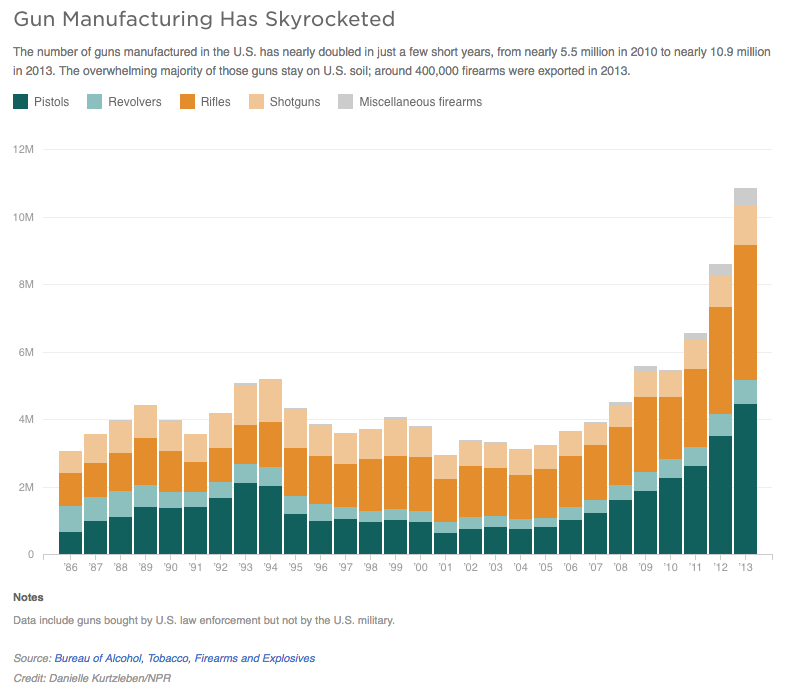
Indeed, gun manufacturing in the USA has skyrocketed.

How Many Guns Are in the U.S.? Likely More Than You Think ...
https://www.npr.org/2016/01/05/462017461/guns-in-america-by-the-numbers

However, the percentage of gun owning households is in decline.

American gun ownership drops to lowest in nearly 40 years - The ...
https://www.washingtonpost.com/resizer/ctbXB0TW65WHKtnDDbmP97IwiM8=/arc-anglerfish-washpost-prod-washpost/public/GOT6JG6AD4YB5M6GIWZIBEHZ3A.png

Also, the number of background checks has risen substantially.

Chart: Firearms Background Checks Are Surging | Statista
https://www.statista.com/chart/12140/firearms-background-checks-are-surging/

The statistics reflect a few trends:
  • Fewer people own guns, but they own more guns.
  • Gun owners are increasingly solid, reliable citizens.
  • The so-called "gun culture" is really rural culture.
  • The USA continues to suburbanize, with 55% of Americans living in suburbs and 20% in "rural" areas (which are also largely suburban in character, and not farms).
  • As rural American shrinks through in-migration to suburbs, the rural identity intensifies.
The greater point is how a conservative value system that values the group and its traditions persists in an environment that relentlessly emphasizes liberal individualism.
Again, for European conservatives, society is a complex organic whole.
In conservative rural America, this holism transferred onto the microcosm of the family and community.
The family and the small town are perceived as complex organisms within an atomisitic liberal worldview.
In fact, this transference of the ideal of an organic whole to a microcosm can even be found among young, urban, over-educated romantics.

They see their own individual psyche as a complex whole, and the mission of their lives is to attain a balanced form of self-fulfillment (for example, the archetype psychology of Karl Jung).

There is an example in philosophy of a complex interconnected world being replaced by an interior organic unity in conception of the "monad".

There were all sorts of problems with Descartes formulation of the mind-body dualism (for example, how mind and body actually connect).

To get around these problems, the philosopher Leibniz theorized that all of existence is purely contained within the subjective experience of each entity in the world.

For Leibniz, even inanimate matter possessed mental states.

https://plato.stanford.edu/entries/panpsychism/#PanpHistWestPhil
Leibniz’s monads are fundamentally to be conceived mentalistically—they are in a way mentalistic automatons moving from one perceptual state (some conscious and some not) to another, all according to a God imposed pre-defined rule. It is highly significant for the development of contemporary forms of panpsychism that Leibniz could find no intrinsic nature for his basic elements other than a mentalistic nature—the only model he found adequate to describe his monads was one of perception and spontaneous activity.
It is as if every single thing in the universe were a brain in a vat watching a movie unique to itself but in sync with the movies that all the other brains were watching.

Experience is thus prerecorded and played out in synchronicity with -- but without connection to -- the predetermined experiences of all other entities.

https://en.wikipedia.org/wiki/Monadology
Leibniz surmised that there are indefinitely many substances individually 'programmed' to act in a predetermined way, each substance being coordinated with all the others. This is the pre-established harmony which solved the mind-body problem, but at the cost of declaring any interaction between substances a mere appearance.
Leibniz's "nomadology" is a perfect description of American life.
In the modern world, there is thus "eversion" or turning inside-out of the traditional worldview.
This might not be unique to the USA.

In traditional societies, there is a public, official, orthodox state religion (e.g., Confucianism) and private mystical heterodox cults (e.g., Taoism, Shinto).

As the orthodoxy, Catholicism adopted an Aristotelian framework which emphasized holism.

For example, the Church is guided by the "principle of totality" in medical ethics, which dictates that the organs of a body are subordinate to the well-being of the organism as a whole.

This comes straight out of Aristotle.

http://www.pages.drexel.edu/~cp28/docdble.htm
Thomas Aquinas followed the philosophy of Aristotle. So, he believed that the universe is organized so that each thing in it has a purpose or goal. Reason helps humans discover and achieve their goals. Actions which are in accordance with our natural goals are good and those that interfere with these goals are bad. So, for example, since we are capable of reasoning we should develop our intellect and since all living things are inclined to preserve their own lives, committing suicide goes against nature and is wrong. 
The Principle of Totality: An individual may not dispose of his organs or destroy their capacity to function, except to the extent that this is necessary for the general well-being of the whole body. Destroying an organ or interfering with its capacity to function prevents the organ from achieving its natural purpose.
Interestingly, in the modern age, the principle of totality becomes the basis of the Church's opposition to abortion.

(The fetus is not regarded by the Church as a subordinate organ that can be removed for the health of the organism, but rather an organism in its own right.)

Even more interestingly, the Church's contemporary concern with abortion is really liberal in orientation -- the focus being on individual rights (of the fetus).

In traditional Christendom, Platonism was the equivalent of a heterodox private religion.

Platonism is more oriented toward a focus on the individual's personal progress up the "divided line" of knowledge toward sun-like realm of pure Forms.

And so alongside the Aristotelian orthodoxy, there is this parallel shadow spirituality in the West that flirts with esoteric knowledge.

In popular form, secret societies mix Platonism with Gnostic and Manichean elements.

In the religious realm, the Renaissance in southern Europe and the Protestant Reformation in northern Europe brought an eruption of unorthodox thought back into Christendom.

The Scientific Revolution in the 1700s overthrew the Aristotelian framework in the private world of scientific research.

The Enlightenment of the 1800s sought to apply the Scientific Revolution to the public, political realm.

The Romanticism of the 1900s is the point in which things were fully turned inside out ("everted").

The private, inner world was now perceived as organic and holistic, whereas the public, outer world was understood as mechanical, atomistic and individualistic.
Hence, the transformation and privatization of conservatism's organic ideal amid the hegemony or domination of a liberal order and an atomistic worldview.
Populism is something altogether different from conservatism or liberalism.
However, because of the USA's unique historical development, those who are the most populist tend to be the most libertarian.
Populist libertarianism runs more deep in certain rural areas of the USA where ancestry can be traced back to the border region between Scotland and England.

[map of self-declared Scotch Irish and "American" ancestry in the USA]

https://en.wikipedia.org/wiki/Scotch-Irish_Americans#American_settlement
Certain rural areas of the USA were particularly slow to act in the coronavirus pandemic.

Where America Didn't Stay Home Even as the Virus Spread - The New ...
Arkansas, and other southern states, slow on the uptake on staying ...
https://www.nytimes.com/interactive/2020/04/02/us/coronavirus-social-distancing.html
These areas might become more afflicted with the coronavirus than the more urban, liberal areas.
There is also the question of who will recover from the coronavirus.

This question is medical and economic, and personal and societal.

Coronavirus afflicts all, but by degree.

Healthy children seem completely unaffected by infection.

There have been a few cases of teenagers without underlying health problems dying.

Young adults, especially healthcare workers, have perished, often excruciatingly.

But the disease is consistently deadly toward elderly people, especially those with health issues.

This pattern may recapitulate itself geographically.
The complacent small towns that already have so many problems may be permanently laid waste.
Now on lockdown, cities that were so recently economically and culturally vibrant may spring back to life.

For the survivors, there may no longer be a housing crisis that now afflicts the cities and suburbs dominated by anti-development NIMBYs.
In fact, cities may emerge more vibrant than they already were.
In that case, culturally, things might veer even more toward the secular and urban than prior to the pandemic.

This is what happened almost seven centuries ago.

[James Burke's "Connections", episode 4, "Faith in Numbers", @17:19]