Monday, November 14, 2016

Reform Ideas: Prison Reform

Prison reform

Some humor on voting for politicians who are narcissistic sociopaths. As far as politicians go, Donald Trump is not that bad a person.


In 1979, the historian Christopher Lasch published the book "The Culture of Narcissism", which was praised by both disillusioned liberals and conservatives. 


The Culture of Narcissism: American Life in an Age of Diminishing Expectations is a 1979 book by the cultural historian Christopher Lasch, in which he explores the roots and ramifications of the normalizing of pathological narcissism in 20th century American culture using psychological, cultural, artistic and historical synthesis.[1] For the mass market edition published in September of the same year,[1] Lasch won the 1980 U.S. National Book Award in the category Current Interest(paperback).

 Lasch proposes that since World War II, post-war America has produced a personality-type consistent with clinical definitions of "pathological narcissism." This pathology is not akin to everyday narcissism, a hedonistic egoism, but with clinical diagnosis of narcissistic personality disorder. For Lasch, "pathology represents a heightened version of normality."[3] He locates symptoms of this personality disorder in the radical political movements of the 1960s (such as the Weather Underground), as well as in the spiritual cults and movements of the 1970s, from est to Rolfing.

Both Donald Trump and the Clintons represent this narcissistic post-WW2 generation.

Unlike their parents, who suffered through the Great Depression and WW2, Baby Boomers were raised in unprecedented affluence. According to this article, this gave them a sense of over-confidence and superiority coupled with moral self-righteousness when they looked at their deferential, conformist parents. Yet, in retrospect, Baby Boomers have accomplished virtually nothing, and are incredibly self-indulgent. (To some extent, the movie "Saving Private Ryan" and other movies that followed were a self-critical reflective moment by aging Baby Boomers like Spielberg.)


(In the PBS Frontline documentary on the Whitewater scandal, Susan McDougal claims that Bill Clinton was not involved in any financial malfeasance, but that Hillary Clinton was screaming at the McDougals "My daughter is going to an elite university, and this is going to pay for it!" In HRC, one finds the perfect fusion of selfishness and intense self-righteousness that characterizes her generation.)  

With the self-absorption and exhibitionism of social media, this tendency toward narcissism in American life has grown more pronounced. But it is nevertheless not the same thing as full-blown Narcissistic Personality Disorder. (The Clintons are Baby Boomers, but they are not mentally ill.)


*Highly competitive in virtually all aspects of his life, believing he (or she) possesses special qualities and abilities that others lack; portrays himself as a winner and all others as losers.
*Displays a grandiose sense of self, violating social norms, throwing tantrums, even breaking laws with minimal consequences; generally behaves as if entitled to do whatever he wants regardless of how it affects others.
*Shames or humiliates those who disagree with him, and goes on the attack when hurt or frustrated, often exploding with rage.
*Arrogant, vain and haughty and exaggerates his accomplishments; bullies others to get his own way.
*Lies or distorts the truth for personal gain, blames others or makes excuses for his mistakes, ignores or rewrites facts that challenge his self-image, and won’t listen to arguments based on truth.

[M]any “grandiose narcissists are drawn to politics, professional sports, and the entertainment industry because success in these fields allows them ample opportunity to demonstrate their winner status and to elicit admiration from others, confirming their defensive self-image as a superior being.”
As a diagnosable personality disorder, narcissism occurs more often in males than females, often developing in the teenage years or early adulthood and becoming more extreme with age. It occurs in an estimated 0.5 percent of the general population, and 6 percent of people who have encounters with the law who have mental or emotional disorders. One study from Italy found that narcissistic personality traits were present in as many as 17 percent of first-year medical students.

Fascinating. Narcissism is rare among ordinary folks, more common among criminals and even more common among medical students. 

The journalist Malcolm Gladwell argues that American business culture has a "star system" that is always on the lookout for the next corporate super-genius. Unfortunately, such a system tends to overlook actual performance, and often elevates self-promoting narcissists. 


In a July 2002 article in The New Yorker Gladwell introduced the concept of "The Talent Myth" that companies and organizations, supposedly, incorrectly follow.[19] This work examines different managerial and administrative techniques that companies, both winners and losers, have used. He states that the misconception seems to be that management and executives are all too ready to classify employees without ample performance records and thus make hasty decisions. Many companies believe in disproportionately rewarding "stars" over other employees with bonuses and promotions. However with the quick rise of inexperienced workers with little in-depth performance review, promotions are often incorrectly made, putting employees into positions they should not have and keeping other more experienced employees from rising. He also points out that under this system, narcissistic personality types are more likely to climb the ladder, since they are more likely to take more credit for achievements and take less blame for failure.[19] 

He states both that narcissists make the worst managers and that the system of rewarding "stars" eventually worsens a company's position. Gladwell states that the most successful long-term companies are those who reward experience above all else and require greater time for promotions.

From the Wall Street Journal, on how narcissists and sociopaths initially rise very quickly through the corporate structure, eventually become very disruptive, then flame out.


Every office full of ambitious people has them. And we have all worked with at least one—the co-worker with an inexplicable ability to rise in the ranks.

"How do they do it?" we may ask ourselves or whisper to friends at work. They don't have more experience.

They don't seem that brilliant.

But such co-workers may possess a dose of one of the personality traits that psychologists call the "dark triad": manipulativeness, a tendency to influence others for selfish gain; narcissism, a profound self-centeredness; or an antisocial personality, lacking in empathy or concern for others. These traits are well-known for the bad behavior that they can cause when dominant in people's personalities. At milder levels, however, they can actually foster skills that can help people rise through the ranks.

Narcissism and sociopathy are not identical, but one thing they have in common is bullying behavior.

The percentage of Americans who are sociopaths is variously given between 1% and 6% (with males three times more prevalent than females); it's a figure that is impossible to know with certainty. Among prisoners (who can be studied), it is estimated to be 25%. Among workers in financial services, it is perhaps 10%. 

Professions that attract the most sociopaths.


1. CEO
2. Lawyer
3. Media (TV/radio)
4. Salesperson
5. Surgeon
6. Journalist
7. Police officer
8. Clergy
9. Chef 
10. Civil servant

Note that these are male-dominated professions often in hierarchal organizations (e.g., civil service) that often require excellent self-presentation skills (e.g., clergy, television journalists, etc.) and coolheaded analysis, without much need for empathy. 

In contrast, here are those professions that are least likely to attract sociopaths.

1. Care aid.
2. Nurse.
3. Therapist
4. Craftsman
5. Beautician/stylist
6. Charity worker
7. Teacher
8. Creative artist
9. Doctor
10. Accountant

Creative artists are often egotistical weirdos, but they do have an ability to empathize with the emotions of others. (In the 2015 movie "Steve Jobs", Jobs is portrayed as a slick salesman and manipulative corporate executive, but his main "flaw" is that he is a visionary creative perfectionist artistic unable to deal with the messiness of real life; in the end, he comes through a moral person.)

Here is a brain scan of a sociopath. 


It is actually the scan of the brain of neuroscientist James Fallon, who took PET scans of his family.


He then compared them to those of dozens of psychopaths in prison.


He found that his own scan was similar to that of psychopaths.

The point of all of this is that narcissists and sociopaths disproportionately fill our prisons, but they also disproportionately run and rule our society.

We have many of the wrong people in prison, and many of the wrong people in power.

Let's look at prison reform.

Conservative politicians take a hard-nosed approach to crime, yet it is disproportionately Republican politicians who wind up in prison. When they get sent to prison, they are shocked by the system and the wasted lives it produces, and they turn toward prison reform.

In this article, prison reformers (many of them conservative politicians) argue that prison should only be for violent offenders. There is supposedly no proof that prison deters most crime or rehabilitates offenders, and so forth. 


Senator Corey Booker responds by asking what they mean by 'violent crime'. Much of the violent crime results from the drug trade, as traffickers fight to expand or defend their turf; this is rational business behavior. These traffickers are, moreover, disproportionately poor minorities. Americans learned by watching HBO's "The Wire" that some drug traffickers easily fit the description of "bad people" -- that is, narcissistic sociopaths (e.g., Marlo Stanfield) -- but most of them are just ordinary people. 

It might not be the type of crime that is important, but the nature of the crime in terms of motive. There are crimes of passion and crimes of profit, and they do need to be prosecuted and punished. But judging from the bullying behavior of narcissistic sociopaths, it is especially important to incarcerate those guilty of crimes of cold-blooded malice. 

It was said in Quentin Tarantino's 2015 "The Hateful Eight", "You only need to hang mean bastards, but mean bastards you need to hang." In the context of prison reform, only crimes of cold-blooded malice should be dealt with in an uncompromising fashion, but they really, really need to throw the book at this type of criminal.

Unfortunately, this type of personality is more likely to dominate our society, so it is mostly ordinary poor people who wind up in prison, instead.

The Netherlands and Norway

What might prison reform look like?

The Netherlands has become a paradigmatic case of prison and sentencing reform.

In the past three years, 19 prisons in the Netherlands have been closed, and more are scheduled for closing.

How do the Dutch do it?

"In the Dutch service we look at the individual," says Van der Spoel.

"If somebody has a drug problem we treat their addiction, if they are aggressive we provide anger management, if they have got money problems we give them debt counselling. So we try to remove whatever it was that caused the crime. The inmate himself or herself must be willing to change but our method has been very effective. Over the last 10 years, our work has improved more and more."

Repeat offenders are given specialized treatment.

He adds that some persistent offenders - known in the trade as "revolving-door criminals" - are eventually given two-year sentences and tailor-made rehabilitation programmes. Fewer than 10% then return to prison after their release. In England and Wales, and in the United States, roughly half of those serving short sentences reoffend within two years, and the figure is often higher for young adults.

There is a pragmatic focus on creating an environment that reduces stress and prepares the prisoner for his or her eventual life in civilians society.

Norgerhaven, along with Esserheem - another almost identical prison in the same village, Veenhuizen - have plenty of open space. Exercise yards the size of four football pitches feature oak trees, picnic tables and volleyball nets. Van der Spoel says the fresh air reduces stress levels for both inmates and staff. Detainees are allowed to walk unaccompanied to the library, to the clinic or to the canteen and this autonomy helps them to adapt to normal life after their sentence. 

The reduced prison population is something recent in the Netherlands, which not so long ago had one of the highest incarceration rates. In particular, the rise of terrorism has forced the Dutch to re-think their priorities.

A decade ago the Netherlands had one of the highest incarceration rates in Europe, but it now claims one of the lowest - 57 people per 100,000 of the population, compared with 148 in England and Wales.

But better rehabilitation is not the only reason for the sharp decline in the Dutch prison population - from 14,468 in 2005 to 8,245 last year - a drop of 43%.

The peak in 2005 was partly due to improved screening at Amsterdam's Schiphol airport, which resulted in an explosion in the numbers of drug mules caught carrying cocaine.

Today the police have new priorities, according to Pauline Schuyt, a criminal law professor from the southern city of Leiden. "They have shifted their focus away from drugs and now concentrate on fighting human trafficking and terrorism," she says.

In addition, Dutch judges often use alternatives to prison such as community service orders, fines and electronic tagging of offenders.

Punishment is still pursued in the criminal justice system, but through other means rather than prisons.

The primary function of prisons is therefor focused on two very different tasks:

1) To isolate prisoners who are extremely dangerous to society, and
2) To protect those prisoners who are most vulnerable to a hostile world.

Angeline van Dijk, director of the prison service in the Netherlands, says jail is increasingly used for those who are too dangerous to release, or for vulnerable offenders who need the help available inside.

"Sometimes it is better for people to stay in their jobs, stay with their families and do the punishment in another way," she says from her brightly lit office at the top of a tower block in The Hague.   

The prison closures might have less to do with a rationalization of policy than with budget cutbacks to policing.

But while recorded crime has shrunk by 25% over the past eight years, some argue that this results from the closure of police stations, as a result of budget cuts, which makes crime harder to report.

Other critics, such as Madeleine Van Toorenburg - a former prison governor and now the opposition Christian Democratic Appeal party's spokeswoman on criminal justice - blame the shortage of prisoners on low detection rates.

Prisons in neighboring Norway can seem more luxurious than even Dutch prisons to American eyes.

But appearances can be deceiving. Prison sentences in Norway begin in maximum security prisons, and conclude in half-way houses that resemble modern homes for the sake of re-habituating the prisoner into society. But the most dangerous criminals are locked up for good.

Only 94 people in Norway, Breivik being one, are sentenced to "preventative detention" in an extra-high-security prison. This means they can be kept beyond the longest sentence permitted by law - 21 years - if they continue to be considered a risk to society.

Norway's prison system does have its critics at home, some of whom think it is too soft. Yet it is hard to argue that it does not work.

When criminals in Norway leave prison, they tend to stay out. Norway's recidivism rate of 20% is one of the lowest in the world. By contrast in the UK it's about 45%, while in the US more than 76% of prisoners are re-arrested within five years.

Defenders of the Norwegian system are also keen to point out how much money is being saved on successful rehabilitation and reintegration.

"Authorities in the US and the UK might want to ask themselves whether all the billions of dollars and pounds they have been spending on locking people up behind tall fences and barbed wire has had any effect at all over the past 150 years," says Tom Eberhardt at the Bastoey prison.

Scandinavians do not see themselves as socialists or liberals or progressives. They see themselves as highly educated, supremely intelligent pragmatists. This is something that Americans, of either the left or the right, cannot seem to understand.

Monday, September 19, 2016

Principles of urban planning: SELF-ORGANIZATION, LOCATION, REWILDING, DURABILITY and BEAUTY and MIXED USE

Perusing the literature, one can identify several principles of sound land development.

1) Self-organizing. The urban planner Donald Shoup's anti-car, anti-regulation approach is understood to reflect the scientific theory of self-organizing systems.

2) Autonomous buildings. Houses and other buildings should strive not only to be energy self-sufficient, but self-sufficient in terms of producing and processing water and waste water. The goal is minimal use of the grid. This would conform to the theory of self-organizing systems.

3) High density and mixed use. These two terms imply one another. Mixed use also accords with self-organization.

4) Location. The best places for land development are in the dry, arid regions. For example, southern California is the ideal environment for land development, whereas northern California should be more off limits. 

5) Rewilding. To some extent, places like northern California should be gradually reconverted to wilderness. 

6) Beauty. Buildings should be more than beige boxes.

7) Durability. As in northern Europe, buildings should be built to last for centuries, unlike the fiberboard McMansions of the United States.

Self-organization and urban planning.


Self-organization is a process where some form of overall order or coordination arises out of the local interactions between smaller component parts of an initially disordered system. 

The process of self-organization can be spontaneous, and it is not necessarily controlled by any auxiliary agent outside of the system. It is often triggered by random fluctuations that are amplified by positive feedback. The resulting organization is wholly decentralized or distributed over all the components of the system.


In effect, a relatively small set of local rules can foster a stable, even sophisticated system.


The idea of self-organized systems was previously introduced and applied to a couple of different aspects of urban planning. 


These were, specifically, parking and autonomous houses.

It was argued that the urban planner Donald Shoup's counterintuitive idea that parking should be deregulated in order to promote walkable cities is a classic case of a self-organized system. Such a system was explained as being largely self-regulating, with a minimum set of rules.


It was likewise argued that building codes should be redesigned to de-emphasize restrictions on height and size. Residential structures would instead be required to be autonomous, or largely off the grid in terms of resource consumption. That is, buildings would be required to produce much of their own electricity and to have starkly low levels of energy consumption; likewise with water consumption; moreover, buildings would to a greater extent than they do now also deal internally with the outputs that they produce (e.g., rain water that otherwise goes into storm drains, and sewerage).

This is not so much de-regulation as it would be re-regulation. For example, if buildings were required to be largely off the grid, this would limit their size.

LOCATION

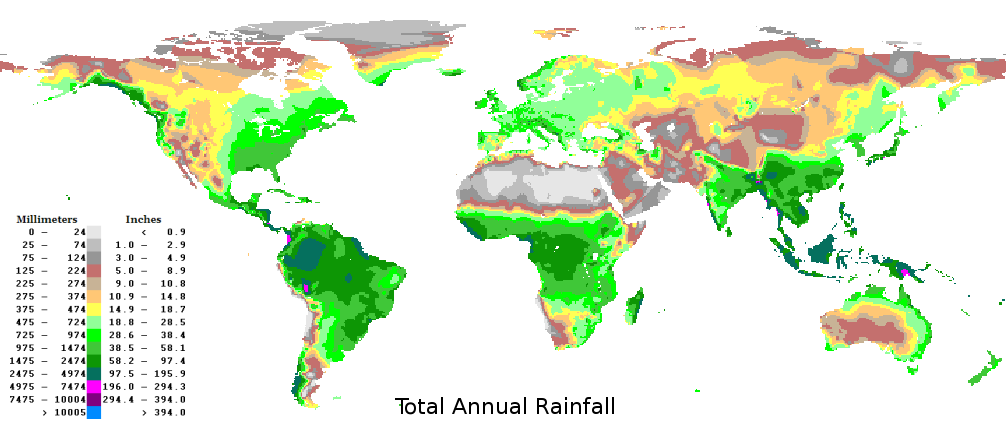
One cardinal rule for development might be that it should be built in areas that have the sparsest signs of natural life.

For example, here is a map of global rainfall patterns.


In the United States, the "best" place for living would be the driest places, which are in the Rocky Mountain states and the southwest.

Here's a glimpse of what land development in the desert looks like.

Las Vegas:


California:


Dubai:


Of course, these desert areas have their own ecosystems, but building in the desert minimizes environmental impact.

What to do with the un-built land?

Rewilding

Rewilding is large-scale conservation aimed at restoring and protecting natural processes and core wilderness areas, providing connectivity between such areas, and protecting or reintroducing apex predators and keystone species. Rewilding projects may require ecological restoration or wilderness engineering, particularly to restore connectivity between fragmented protected areas, and reintroduction of predators where extirpated.

The warmest and rainiest regions of the US should be rewilded. That would be the southeast, but also northern California, and to a lesser degree, the Pacific northwest and the northeastern United States.

Durability


To understand the need for ultra-durable buildings, one must first understand the concept of “embodied energy”.

Embodied energy is the sum of all the energy required to produce any goods or services, considered as if that energy was incorporated or 'embodied' in the product itself. The concept can be useful in determining the effectiveness of energy-producing or energy-saving devices, or the "real" replacement cost of a building, and, because energy-inputs usually entail greenhouse gas emissions, in deciding whether a product contributes to or mitigates global warming. One fundamental purpose for measuring this quantity is to compare the amount of energy produced or saved by the product in question to the amount of energy consumed in producing it.

Embodied energy is not just numerical figure of total energy inputs into a product, but the method of estimating that number.

The history of constructing a system of accounts which records the energy flows through an environment can be traced back to the origins of accounting itself.

Embodied energy is an accounting method which aims to find the sum total of the energy necessary for an entire product life-cycle. Determining what constitutes this life-cycle includes assessing the relevance and extent of energy into raw material extraction, transport, manufacture, assembly, installation, disassembly, deconstruction and/or decomposition as well as human and secondary resources. Different methodologies produce different understandings of the scale and scope of application and the type of energy embodied.

Embodied energy is crucial to understanding energy inputs over a building’s lifespan. One irony is that because more resources are being invested today in making buildings energy efficient, those buildings are more expensive to construct, and thus have higher levels of embodied energy.

Although most of the focus for improving energy efficiency in buildings has been on their operational emissions, it is estimated that about 30% of all energy consumed throughout the lifetime of a building can be in its embodied energy (this percentage varies based on factors such as age of building, climate, and materials). In the past, this percentage was much lower, but as much focus has been placed on reducing operational emissions (such as efficiency improvements in heating and cooling systems), the embodied energy contribution has come much more into play. Examples of embodied energy include: the energy used to extract raw resources, process materials, assemble product components, transport between each step, construction, maintenance and repair, deconstruction and disposal. As such, it is important to employ a whole-life carbon accounting framework in analyzing the carbon emissions in buildings.

The price of a product tends to be directly proportional to its embodied energy. One irony of this is that electric cars tend to cost more, and so they have higher initial energy inputs (embodied energy). 

The longer a product lasts, the more its embodied energy is, in a sense, amortized.

The same might be said of renewable energy resources. An array of solar panels might cost $10,000 and last for 30 years. In a sense, those panels represent $10,000 of carbon entering the atmosphere in the form of the embodied energy; yet if those panels pay for themselves in ten years, over the next 20 years they will preclude $20,000 worth of carbon from entering the atmosphere. 

Likewise, a concrete home might have higher energy inputs in its construction than a wooden house. But the concrete home might last for centuries, precluding further embodied energy inputs.

In Japan, homes are not built to last for a long time. This is both a financial and environmental problem.

In Western countries, a home is typically an investment that most people expect to one day sell at a profit. In Japan, a house is a consumer good that rapidly depreciates in value, like a car. Because Japanese house hunters prize new construction, they will pay a premium for land, but build their own home on it.

S-House architect Yuusuke Karasawa said the average life of a Japanese house is actually about 15 years. “Fundamentally, Japanese people do not like secondhand houses,” he said.

There has been much speculation about this phenomenon, for example, here and here. 

It has been attributed to multiple sources: The relative high cost of land in Japan, which leaves little money left over for a substantial home; the historic disposability of light, wooden houses designed for a country prone to earthquakes; the poor quality and small size of homes built during Japan’s boom years from the 1950s to the 1970s; ever-changing safety regulations; the human tendency to imagine that something of a previous owner’s personality adheres to an object, which is an intense feeling in Japan; the powerful desire to express oneself uniquely in one’s personal life as an escape from a disciplined, regimented society; all of these reasons combine in a self-fulfilling prophecy of rapid home obsolescence.

Embodied energy is also a challenge for public policy in terms of infrastructure and facilities.

In the case of Australia, during a ten-year drought, the government spent more than $10 billion constructing desalination plants. But when the drought ended, those plants were mothballed. Environmentalists heaved a sigh of relief for the petroleum that would not have to be burned in order to run the plants. 

But that misses the point. In terms of embodied energy, in a sense, $10 billion worth of carbon was poured into the atmosphere to build those unused plants.

In terms of neglecting the reality of embodied energy, another problematic public policy was the "Car Allowance Rebate System" (CARS), colloquially known as "Cash for Clunkers", which lasted throughout July, 2009. 

Here is the eligibility criteria:


  • Vehicle must be less than 25 years old on the trade-in date.
  • Only the purchase or 5 year minimum lease of new vehicles qualify.
  • Generally, trade-in vehicles must get a weighted combined average rating of 18 or fewer miles per gallon (some very large pickup trucks and cargo vans have different requirements).
  • Trade-in vehicles must be registered and insured continuously for the full year preceding the trade-in.
  • Trade-in vehicles must be in driveable condition.
  • The program ran from July 1, 2009 until August 24, 2009
  • The program requires the scrapping of the eligible trade-in vehicle and that the dealer disclose to the customer an estimate of the scrap value of the trade-in. The scrap value, however minimal, will be in addition to the rebate, and not in place of the rebate.
  • The new car bought under the plan must have a suggested retail price of no more than $45,000, and for passenger automobiles, the new vehicle must have a combined fuel economy value of at least 22 mpg.

  • One problem is that the description above of trade-in vehicles is that they were not really "clunkers". Some were relatively new cars. That they were SUVs or trucks that got poorer mileage than the vehicles that replaced them does not take into consideration the energy that the so-called "clunkers" embodied. In some cases, the government might have been effectively subsidizing the dumping of more carbon into the atmosphere.

    The issue of embodied energy is overlooked in the construction of nuclear power plants. 


    The cost of a large nuclear power plant is about $10 billion. That's a lot of carbon that is produced building such a plant, even though the plant may not be producing greenhouse gases as a bi-product of generating electricity.

    Silicon Valley

    Land development in Silicon Valley would be a test case of these principles.


    CUPERTINO, Calif. — Silicon Valley is bent on disrupting the world. Its products affect how millions upon millions of people live and work. But when it comes to the physical space that many technologists call home, there are increasing demands to leave things alone.

    The heart of Silicon Valley is a 75-mile strip of land anchored by San Francisco at one end and San Jose at the other. In between is a suburbia strewn with corporate campuses and the estates of those who run them. Congested and forbiddingly expensive, it is a region choking on its own success.

    There has been a backlash in Silicon Valley against further land development.

    “Silicon Valley has been flashing a ‘vacancy’ sign for decades — come here and build a company,” said Larry A. Rosenthal, a specialist in land use and urban policy at the University of California, Berkeley. “Now some people are saying, ‘We’ve hit our limit.’ They may be reaching their threshold tolerance for pain.”

    On Tuesday, voters across Silicon Valley will vote on a slew of initiatives intended to rein in that growth. In one community, they can keep houses off the surrounding hills for 20 years; in another, they will have the option to reduce an already low annual cap on housing construction; in a third, there is a measure to restrict sprawl.

    At the heart of it all is a fondness for suburban life and an aversion to cities.

    “We’re going from suburban to urban, with nothing in between,” said Lisa M. Gillmor, the mayor of Santa Clara, a hub for tech companies. “The community is reacting in a hugely negative way. We almost have riots.”

    The fate of a former shopping mall is emblematic. Developers want to turn it into an vast office space with some apartments.

    Here in Cupertino, the hometown of Apple, voters will decide the fate of a ghost mall called Vallco, once home to Macy’s, Sears and J.C. Penney. The developers promise a futuristic remake that includes the world’s largest green roof, 800 apartments and two million square feet of office space. The architect Rafael Viñoly said it was the most important project of his career.

    All those offices will add up to at least 10,000 jobs, say opponents who wonder where all those people are going to live. Only a few will be able to afford Cupertino, a city of 60,000 where the median home price is $1.6 million. But traveling a long distance to cheaper communities will further stress the area’s jammed roads, and some of those communities do not want to house large numbers of commuters in the first place.

    With the principle of mixed use in mind, and with it high density, it might have been best to build apartments that would potentially house those 10,000 workers. Eight hundred apartments does not cut it, and the housing shortage on site represents a commuting nightmare.

    A dozen miles northwest of the Vallco mall is Palo Alto, with a small-town atmosphere that many residents cherish but that also serves as an incubator for many start-ups.

    “We have a pretty insatiable demand for whatever office space we construct until there’s 24-hour gridlock and people say, ‘What’s the point?’ ” said Mayor Pat Burt, who is a start-up entrepreneur himself. His instinct is for moderation: “A glass of wine at dinner is good. Chugging a gallon is not.”

    The proposed solution is to slow down the construction of new office space. 

    That might not make as much sense as building residential units in place with any new office space.

    About one-third of voters in Silicon Valley are now wary of new growth. They are often called 'residentialists' -- meaning, they seek to defend the residential suburbs, as opposed to the emergence of a genuine city.

    In Palo Alto’s recent survey of registered voters, 30 percent said too much growth and development was either a very or an extremely serious problem. Such sentiments are reshaping the political landscape, powering what are called locally “the residentialists.”

    Eleven candidates are vying on Tuesday for four slots on Palo Alto’s City Council. Nearly all say they support an annual cap of 50,000 square feet of new office space, a limit enacted last year. Several endorsed an outright moratorium on new construction.

    That does not reflect a perfect consensus.

    That makes Leonard Ely, a candidate who is a third-generation Palo Altan, something of an anomaly. Mr. Ely is a commercial real estate broker, but his advocacy for growth goes beyond his profession.

    “People always want to keep everything the way it is,” he said. “If my grandmother had been a residentialist, a lot of these people wouldn’t be here. There would still be orchards.”

    He favors more expansive height limits in the low-slung downtown. But this, he knows, is extremely unlikely. “A lot of people say I’m crazy for running,” he said.

    Mr. Ely is completely correct about the need for deregulated building heights downtown -- and everywhere else. Development should be as big and tall as possible. This is in keeping with the principles of mixed use and high density.

    But Mr. Ely is tragically incorrect that this are should have been suburbanized in the first place. In fact, perhaps it should not even have been farm land as it was in his grandmother's time. Ideally, it should be wilderness. Northern California, to some extent, should be a national park. 

    Silicon Valley, in a perfect world, should not exist between San Francisco and San Jose. 

    It should exist between Los Angeles and San Diego.

    This is in keeping with the principle of restricting growth to drier, arid regions with a less developed ecosystem.

    The characteristic development of southern California, with its highways and water system drawing water from the north, was the work of Governor Edmund "Pat" Brown, who served in that post from 1959 to 1967.

    Liberals love cities, and lament the "suburban sprawl" of southern California (even though when moves are made to transform the suburbs into city, liberals panic, and become the great enemies of urbanization). 

    But Governor Brown was from northern California, and it is sometimes theorized that he rapidly developed the south in order to protect his hometown. 

    This was the right thing to do. The problem is not the "overdevelopment" of southern California, but its current underdevelopment as a collection of low-rise suburbs. It needs to become a great city.

    But there are signs of change, even in Silicon Valley.

    Financially, office construction brings in tax revenue, whereas homes are a drain on public coffers.

    The town of Mountain View, Google’s home, wants to do something about that. Given new marching orders from a reform-minded City Council that was swept into office here two years ago, Mountain View is looking to increase its housing stock by as much as 50 percent — including as many as 10,000 units in the area around Google’s main campus.

    “We need to provide housing because there’s a housing shortage,” said Lenny Siegel, a Mountain View councilman. That may seem an obvious tautology, but it turns out to be highly contentious in a state where most cities and suburbs are still dominated by anti-growth politics that seek to maximize the construction of tax-generating offices while minimizing the number of budget-depleting residents.

    That explains a lot.

    Things are changing, but the old attitudes persist.

    Many employees say they would prefer to live closer to work. But these companies reside in small cities that consider themselves suburbs, and the local politics are usually aligned against building dense urban apartments to house them.

    Take Palo Alto, the Silicon Valley city that has become emblematic of the state’s reputation for rampant not-in-my-backyard politics. Palo Alto has one of the state’s worst housing shortages. With about three jobs for every housing unit, it has among the most out-of-balance mixes anywhere in Silicon Valley.

    But instead of dealing with this issue by building the few thousand or so apartments it would take to make a dent in the problem, the city has mostly looked to restraining a pace of job growth that the mayor described as “unhealthy.”

    Farther up the peninsula near San Francisco, the small city of Brisbane told a developer that its proposal for a mixed-use development with offices and 4,000 housing units should have offices for about 15,000 workers, but no new housing.

    Play that out a thousand times over and the crux of the state’s housing crisis is clear: Everyone knows housing costs are unsustainable and unfair, and that they pose a threat to the state’s economy. Yet every city seems to be counting on its neighbors to step up and fix it.

    But change is happening. Mixed-use urban mega-projects are the way to go.

    Mr. Siegel, the city councilman, wants to turn this prototypical example of sprawl into a bustling urban neighborhood. The city has plans for nearly 10,000 new apartments and hopes that businesses like a grocery store, bars and retail shops will follow them.

    Here in Mountain View, as in many places, residents are mostly aligned against putting too many apartments near the city’s core single-family-home neighborhoods. The city is looking to create new neighborhoods by pushing growth to areas like North Bayshore, where there are already a lot of jobs and few neighbors to complain.

    Versions of that strategy are taking hold across the Bay Area.

    Given the political resistance to new housing and the cascade of lawsuits that are a good bet to follow any new proposal, Mr. Meany said he and other developers were more likely to focus on mega-projects with a bigger payoff.

    “A planner would go out and say, ‘We should do things regionally and scatter housing throughout the area,’” he said. “But if you’re the developer who has to actually get it done, it is better to go off and find large areas of problematic land than trying to choose the smartest location.”

    Friday, July 15, 2016

    Changes in American political geography (2016 election)

    Can Trump win?

    There are those who argue that Donald Trump can win the 2016 presidential election.

    The theory is that  that the kind of people that will vote for Trump are either
    1) off the radar in terms of political polling, or 
    2) visible politically, but hide their enthusiasm for Trump.

    There might be more of these people than anyone imagines.

    It might be the case that Trump could win the popular vote, the way Al Gore did. But like Gore, Trump might still lose the Electoral College.

    This is because the Electoral College is packed with old-school, establishment insiders.

    Here is an example of an establishment Republican who is openly in support of Hillary Clinton.

     (CNN)Hillary Clinton, the presumptive Democratic presidential nominee, received an endorsement Wednesday from a heavyweight foreign policy adviser to Republican presidents.
    Brent Scowcroft, who served as National Security Adviser to Presidents George H. W. Bush and Gerald Ford, and who worked in the White House of Presidents Richard Nixon and George W. Bush, said Clinton "brings truly unique experience and perspective to the White House."
    His endorsement was released hours after the Republican presumptive nominee Donald Trump launched a broad attack on Clinton's experience, honesty and foreign policy experience in a 40-minute speech. Scowcroft directly rebutted Trump's claim that Clinton does not have the temperament to lead, citing her experience working on high-pressure issues such as Iran and Israel.
    "She brings deep expertise in international affairs and a sophisticated understanding of the world, which I believe are essential for the commander-in-chief," Scowcroft said. 

    These are the kind of elite insiders who inhabit the Electoral College. If Trump should win the popular vote in, say, Florida, that state will send it's Republican delegation to vote in the Electoral College. But not all of them will vote for Trump. That is the whole point of the Electoral College: To sabotage populist movements institutionally.

    This is the historical moment that our Founding Fathers were planning on when they created the Electoral College.

    It is an un-democratic institution. That was always the purpose of the Electoral College.

    The real question that this raises is, How many old-school Republicans will vote for Clinton ... and keep on voting Democratic?

    The Republican Party is now transformed, and in tatters. If the Democrats offer the kind of "elite establishment insiders" like Hillary Clinton, some old-school Republicans might make it a habit to vote for them. 

    Conversely, Donald Trump's greatest supporters are registered as Democrats. These are poorly educated, small-town white Protestants. Now many of them may continue to vote Republican. 

    The real question.

    The real question might be, Will there here may be a major re-alignment in the two parties, as there has been before? 

    Let's look at the old alignments.

    North versus South.

    There has always been a party of the North and a party of the South, this is a major demarcation. 

    The party of the north seeks centralization, while the south seeks decentralization. That was the story of the Civil War, when the North was Republican (centralists) and the South was Democratic (decentralists). 

    The New Deal.

    The New Deal of the 1930s changed this somewhat. The Democratic Party -- the party of the South -- embraced the New Deal's centralism, whereas the Republican Party of the industrial and financial elites of the North rejected the New Deal and its centralizing tendencies. However, this still fits in with the South's conception of itself as 'rebellious', populist and anti-elitist. 

    The 1970s.

    The next great change happened in the 1970s. The Republican Party under Nixon reached out to white Southerners and Roman Catholics. The South is now Republican. But this is in some ways a Republican Party that espouses de-centralization, whereas the Democrats since the New Deal have embraced centralization. It's not that Southerners have converted ideologically, so much as the Republicans have, at least rhetorically and superficially, adopted de-centralization and populism (e.g., George W. Bush, as opposed to his father).

    East versus West.

    Another geographic demarcation since the Civil War was conflict between the eastern and western regions of the United States, which again expressed itself as the conflict between elitism and populism. One can see this played out today in the conflict between the urban, liberal coastal 'blue states' and the more rural interior 'blue states' of the US.


    There is a third and more recent demarcation based on geography, and that is the geography of upward mobility. 

    A new geography of political competition in the US?

    Here is a map that illustrates how social mobility is lowest in 1) the southeastern US and in 2) the declining 'rust belt' areas of the northeast -- which excludes prosperous New England. 


    This map of social mobility rates corresponds with areas of support for Donald Trump (the south and the lower north), on the one hand, and Bernie Sanders (the west and New England), on the other. 


    This might be the new red-state, blue-state map. But even Texas is more upwardly mobile, and is not so interested in Donald Trump. They might vote for Trump to avoid Clinton, but there is no excitement for Trump in most of the big, successful states.

    One thing that many observers are not noticing or admitting is that candidate Trump is speaking to the realities of white rural life, not just subjectively as it may feel to small-town folks, but also in terms of the actual, objective conditions of their existence that elites know nothing about.

    One Ohio county has since 1964 voted consistently for the presidential candidates who ended up winning. It is now leaning toward Trump. They might not like Trump, but they are voting for him because all the other candidates seem to be out of touch with reality.

    In a county in North Carolina in which the factories generally shuttered back in 2009, the only good jobs in town now are custodial, but those jobs belong to Mexicans. Trump's rantings about Mexicans and Chinese stealing American jobs is simply a fact of life in these areas. (One young woman in the story is walking around with an infant in her arms. She works three part-time jobs to get by. Interestingly, she has an MA degree. The notion of education as a panacea might be unrealistic.)

    American ranchers along the Mexican border discuss the regular trespassing on their property by Mexicans. It used to be migrant workers, but no longer, now it is drug traffickers. They laugh at Trump's idea of a great border wall, but say that only Trump is discussing the reality that is their lives.

    Sunday, July 10, 2016

    Reform Ideas: The Nature of Reform


    The Nature of Reform

    Q: What is essential to know in proposing reform?

    A: People want change – but simultaneously do not want change.

    This is the dilemma that designers face: Corporations and consumers want the latest hot, bold design, but are repulsed by something that is too novel and feels alien, even if it is the best design.


    People have a strong emotional attachment to things that they are used to, even things that are annoying and useless to them.

    The penny is a classic example. Americans hardly use pennies and find them a nuisance, but they resist eliminating the penny, because it is uniquely copper-colored, and because it has Abraham Lincoln on it (and because the zinc industry lobbies hard to keep it because the penny today is mostly zinc). 

    The United States had a half-penny which it eliminated in 1857. Today, it would be worth 13 cents, taking inflation into account. So nickels and dimes are also obsolete.


    So, how to replace the penny? Create a dollar coin with Abraham Lincoln on one side, and Benjamin Franklin on the other, and call it a “Benny”. Because of inflation, new coins of a higher denomination eventually need to be minted. The alternative would be to use digital currency, but that is vulnerable to disruption (hacking, power outages) and subject to surveillance by governments and corporations. 

    The point is, there needs to be some continuity.